
Discover Shri Radha Madhav Mandir, Mayapur India
Explore the spiritual sanctuary of the Shri Radha Madhav Mandir complex. Discover the divine presence of Sri Sri Radha Madhava and their Ashta-sakhis, along with rare forms of Lord Nrisimhadeva and the Pancha-tattva. Immerse yourself in the rich history of ISKCON, including Srila Prabhupada’s personal quarters and a captivating Chaitanya Exhibition.
Features of Shri Radha Madhav Mandir
- The Shri Radha Madhav Mandir features several significant altars. On the left side is a murti of ISKCON’s Founder-Acharya, Srila Prabhupada. On the main altar to the right are the presiding deities: Shri Radha Madhava with their Ashta-sakhis (eight principal gopi friends) and also Gauranga Mahaprabhu and Giri-Govardhana.
- In the center stands Lord Nrisimhadeva in a rare form known as “Sthanu-Nrisimha,” ready to protect devotees. Adjacent to this is the Sri Sri Pancha-tattva temple featuring Sri Chaitanya Mahaprabhu with His associates.
- The Shri Radha Madhav Mandir also houses the Chaitanya Exhibition depicting Lord Chaitanya Mahaprabhu’s pastimes through beautiful bas-reliefs and audio narrations in Bengali.
- Upstairs, visitors can see the preserved rooms used by Srila Prabhupada in 1976-77, including his personal quarters and a darsana room with his deity of Sri Mayapur-chandra and personal belongings displayed.
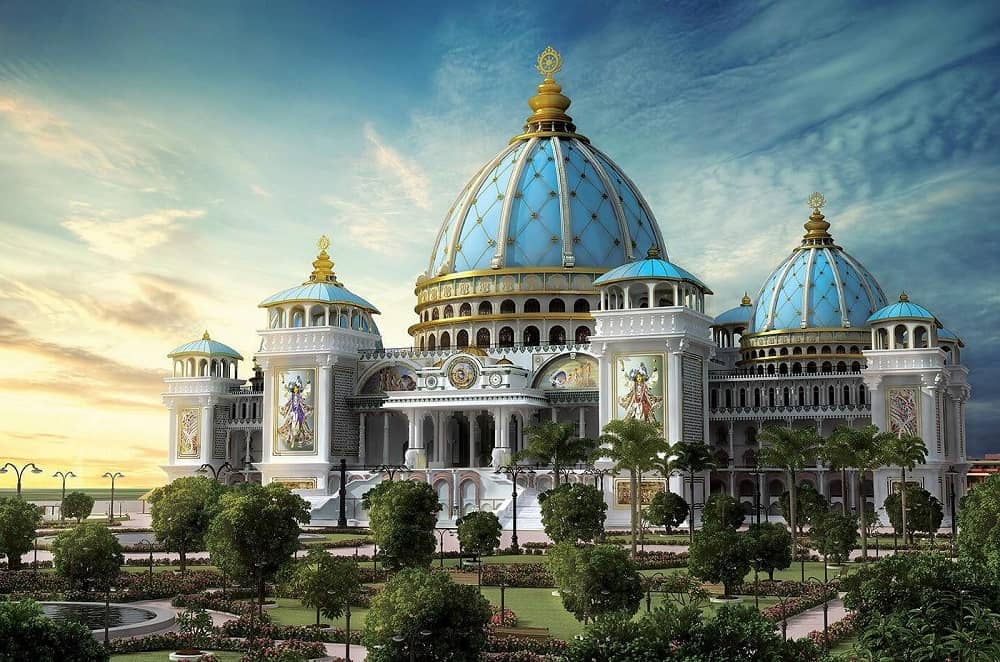
Suggested Read: TOVP Mayapur Temple India
Timings of Aarti, Bhajan, Kirtan and Lecture on Bhagavat Gita
- Mangala-arati of Shri Radha Madhav Mandir: 4:30am (closes at 5:00am)
- Darsana-arati of Shri Radha Madhav Mandir: 7:00am
- Srila Prabhupada Guru-puja at Shri Radha Madhav Mandir: 7:30am
- Class on Srimad-Bhagavatam (English and Bengali separately): 8:00am
- Bhoga-arati of Shri Radha Madhav Mandir: 12 noon (temple closes at 1:00pm and reopens at 4:00pm)
- Sandhya-arati of Shri Radha Madhav Mandir: 6:30pm
- Class on Bhagavad-gita (Bengali): 7:45pm (temple closes at 8:30pm)
Srila Prabhupada’s Pushpa Samadhi Mandir
Srila Prabhupada’s Pushpa Samadhi Mandir is India’s largest memorial shrine dedicated to him. Its grand marble dome stands prominently against the sky, glowing in the sunrise and sunset. Inside, a larger-than-life brass murti of Srila Prabhupada is worshipped, surrounded by beautiful gardens that captivate visitors.
The Samadhi Mandir also features a diorama depicting Srila Prabhupada’s life and struggles, along with terra-cotta displays of Krishna’s pastimes from the Srimad-Bhagavatam on its walls.
Additionally, the basement hosts a large auditorium equipped for cultural programs, seminars, and ISKCON film shows. The Samadhi Mandir welcomes guests daily from 7:30am to 1pm and again from 3:30pm to 8:30pm, with key aratis including Srila Prabhupada arati at 4:00am, Guru Puja at 7:30am, Bhoga-arati at 12:15pm, and Sandhya-arati at 6:00pm.

Srila Prabhupada’s Bhajan Kutir
Srila Prabhupada’s Bhajan Kutir, located just inside the main gate of ISKCON Sri Mayapur, is a straw hut where Srila Prabhupada resided from 1972 to 1976. Following his instruction, continuous 24-hour kirtana (chanting of the holy names) takes place here, fulfilling his desire for constant devotional singing in the holy dhama.
Adjacent to the hut are large neemwood Deities, Sri Sri Nitai Gaurasundara, who traveled across India on Pada-yatra. These Deities are taken out in procession on Saturdays after evening arati during the winter months from Kartika to Gaura-purnima.
Srila Prabhupada’s Bhajan Kutir remains a cherished site, maintained as per his wishes. Since 1990, nonstop Harinama Kirtana has resounded here, persisting through significant floods in 1999, 2000, and 2006. Sixteen devotees participate in this service, organized into eight shifts of three hours each, ensuring the eternal continuity of this devotional practice to please Srila Prabhupada.
Other Famous Temples in Mayapur
1. Jagannatha Mandir
The Jagannatha Mandir in Simantadvipa, near Mayapur, has a rich history steeped in devotion and miraculous events. Centuries ago, Jagadish Ganguli, a devout pilgrim, was blessed with restored vision by Lord Jagannatha Himself in a dream. Directed by the Lord, Jagadish commissioned a blind carpenter to carve deities of Jagannatha, Baladeva, and Subhadra, curing the carpenter’s leprosy in the process.
Over time, the temple and its deities were neglected until rediscovered miraculously unharmed within a termite hill. In 1978, foreseeing neglect again, the temple priest entrusted the deities to ISKCON, ensuring their continued worship. Today, the temple stands as a testament to faith and divine grace, offering spiritual solace and the opportunity to partake in Lord Jagannatha’s blessings through His Maha-Prasadam.
2. Navadwip Mandal
Navadvipa Mandal, also known as Gaura Mandala, encompasses a sacred area of over 200km in circumference, with the Ganges River flowing through its center. It is shaped like a hundred-petaled lotus, with Navadvipa as its focal point. Navadvipa consists of nine islands (dvipas), each resembling an eight-petaled lotus flower, and each representing a different aspect of devotional service.
- Antardvipa (Shri Mayapur): Represents surrendering everything.
- Simantadvipa: Represents hearing.
- Godrumadvipa: Represents chanting.
- Madhyadvipa: Represents remembering.
- Koladvipa (Navadvipa city): Represents serving the lotus feet.
- Ritudvipa: Represents worshiping.
- Jahnudvipa: Represents praying.
- Modadruma-dvipa: Represents being a servant.
- Rudradvipa: Represents being a friend.
3: Yogapitha (Sri Chaitanya Mahaprabhu’s Birthplace):
Located at the center of Navadvipa, Yogapitha is where Sri Chaitanya Mahaprabhu appeared. It houses a small temple with deities of Jagannath Misra, Sacidevi, and young Nimai. Nearby, there’s a neem tree marking the exact spot of Mahaprabhu’s appearance. The area also includes a temple of Sri Gaura-Gadadhara and Sri Lakshmi Nrisimhadeva, along with Gaura-kunda excavated by Srila Bhaktisiddhanta Sarasvati Thakura.
4. Sri Srivasa Angan:
This site, just 250 meters from Yogapitha, is where Sri Chaitanya and his associates performed continuous kirtan. It features shrines dedicated to Radha Krishna, Sri Caitanya Mahaprabhu, and Prabhu Nityananda.
5: Sri Caitanya Gaudiya Matha:
Established by Srila Bhaktisiddhanta Sarasvati Thakura in 1918, this matha served as his headquarters for preaching. It includes temples for Sri Sri Gandharvika-Giridhari, Lord Chaitanya Mahaprabhu, and samadhis for Srila Bhaktisiddhanta Sarasvati Thakura and his spiritual master, Srila Gaurakisora das Babaji Maharaja.
6: Nandana Acarya’s House:
This is where Lord Nityananda and Lord Chaitanya first met in their manifest pastimes. The main temple, Sri Sri Gaura-Nityananda Mandir, houses deities of Gaura-Nitai, Radha Vinoda-vihari, and Nrisimhadeva.