
Unveiling the Lotus Temple Delhi inside’s Architectural Masterpiece
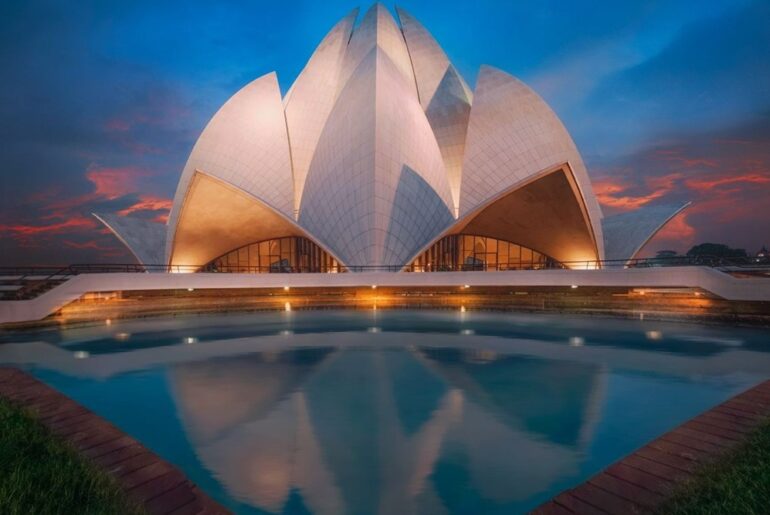
The Baháʼí House of Worship in New Delhi is globally recognized for its breathtaking exterior, a pristine white marble structure famously shaped like a half-opened lotus blossom.
Overview: Lotus Temple Delhi inside
Millions flock annually to capture its beauty against the bright Indian sky. Yet, to truly understand this landmark’s genius and spiritual profoundness, one must step past the manicured gardens and reflecting pools and explore the extraordinary atmosphere that defines the lotus temple delhi inside.
This guide is your deep dive into the historical origins, the world-class structural secrets, the spiritual principles that shape the experience, and all the essential visitor details required to plan your perfect day at this universally welcoming sanctuary.
The Genesis of Glory: History and Architectural Philosophy
The conception of this monumental edifice began not as a mere tourist attraction, but as the Mother Temple of the Baháʼí Faith for the Indian subcontinent.
A Decade of Dedication
The commission was awarded to the Iranian-Canadian architect Fariborz Sahba in 1976. Sahba embraced the task with a profound vision, spending nearly a decade on design and construction. He drew inspiration not only from his faith’s principles but also from India’s deeply rooted cultural symbols.
The lotus, which symbolizes purity, spiritual awakening, and light across Hinduism, Buddhism, and Jainism, was the perfect motif to express the Baháʼí principle of the oneness of humanity and religion.
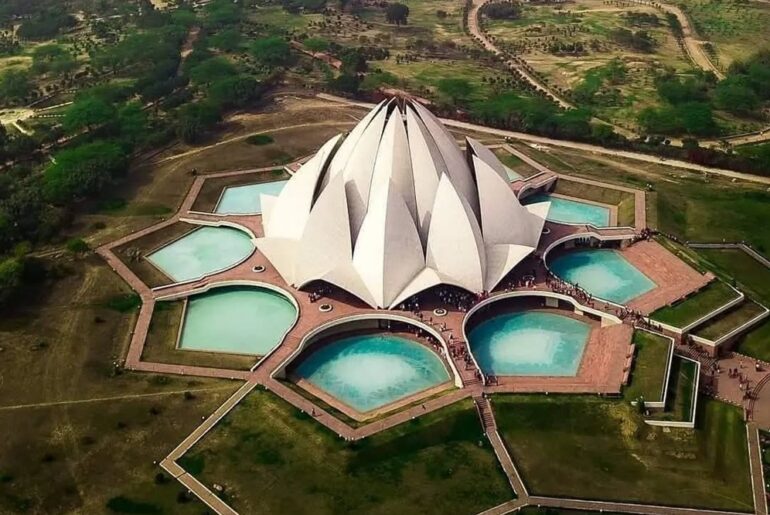
Construction commenced in 1980 and took six painstaking years. It was an exercise in pure structural expressionism, completed in December 1986. The final product is a non-agonal (nine-sided) circular plan, where every element—from the entrances to the surrounding pools—is repeated nine times, symbolizing completeness and the universality of the faith.
The Shell Structure: An Engineering Marvel
The exterior’s appearance of delicate, unfurling petals belies the colossal structural complexity beneath. The entire building is composed of 27 enormous free-standing “petals,” crafted from white exposed concrete shells, soaring to a height of over 34 meters. These petals are organized into three distinct groups:
- Entrance Leaves: The outermost layer, which opens outwards to form the nine primary entrances to the structure.
- Outer Leaves: The middle layer, which arches inward, covering the peripheral hall space.
- Inner Leaves: The innermost layer, which forms the main superstructure of the central hall. These leaves curve inward and approach one another, but crucially, they do not meet at the very top.
This design requires extraordinary structural integrity, especially given Delhi’s seismic zone. The British firm Flint and Neill provided the structural design, which involved using a complex system where the main dome rests on a delicate, hovering compression ring concealed within the tiered seating.
This revolutionary use of concrete and geometry earned the structure international acclaim, including recognition by the American Concrete Institute as one of the finest concrete structures ever built.
Suggested Read: Discover the options from New Delhi to Rishikesh By Bus
Stepping Past the Gates: Location and Practical Details
Locating this New Delhi jewel is straightforward, thanks to its proximity to excellent transport links.
Finding the Baháʼí House of Worship
The structure is centrally positioned in South Delhi, in the Bahapur, Kalkaji area, not far from the bustling Nehru Place commercial hub.
The most hassle-free route for most visitors is the Metro:
- Closest Metro Station: The Kalkaji Mandir Metro Station is the primary access point. As an interchange for the Violet Line and the Magenta Line, it offers excellent connectivity from across the city. The temple entrance is just a brief, sign-posted walk (approximately 5-7 minutes) from the station exit.
- Road Access: The complex is easily reachable via cabs, app-based ride services, and auto-rickshaws. Dedicated parking facilities are available for private vehicles, though these areas can fill up quickly, particularly during peak visitor seasons.
Essential Visitor Information (Timing and Entry)
For a smooth visit, confirm the following non-negotiable details:
| Detail | Consideration |
|---|---|
| Operational Days | Open Tuesday through Sunday. The facility is closed every Monday. |
| Operational Hours (Summer) | April to September: Generally 9:00 AM – 7:00 PM. |
| Operational Hours (Winter) | October to March: Generally 9:00 AM – 5:30 PM. |
| Admission Cost | Entry for all visitors is completely free of charge. Donations are only accepted from members of the Baháʼí Faith. |
| Etiquette | Shoes must be removed (free check-in provided). Silence is mandatory inside the Prayer Hall. |
The True Sanctuary: The Experience Inside the Temple
The most profound part of the visit is the journey from the hot, noisy Delhi air into the cool, silent core of the temple.
The Architecture of Light and Silence
As you approach the nine grand entrances, the vastness of the central prayer hall is revealed. It soars over 40 meters high, with a circular diameter that provides a vast, column-free space capable of accommodating approximately 1,300 seated individuals and up to 2,500 people in total.
The interior is defined by stark, beautiful simplicity. In keeping with Baháʼí doctrine, you will find:
- No Idols, Statues, or Imagery: The walls are bare, allowing the architectural geometry to take center stage. This deliberate minimalism ensures that nothing mediates the individual’s connection with the Creator.
- No Pulpits or Altars: The lack of ceremonial focal points reinforces the principle that all people are equal in the sight of God.
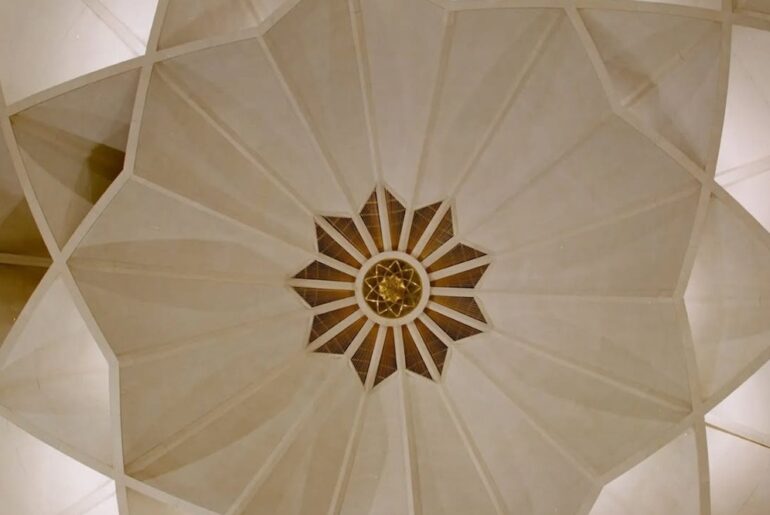
- The Ambient Glow: The most striking feature inside is the spectacular illumination. The inner leaves of the dome do not meet, and at the apex, a hidden glass and steel skylight allows natural sunlight to filter down. This light is diffused softly by the inner folds of the marble petals, bathing the entire hall in a peaceful, ethereal glow. The effect is designed to inspire reverence and contemplation.
The Ingenuity of Passive Cooling
Beyond the aesthetic, the design utilizes ancient principles of environmental sustainability:
- The Nine Reflecting Pools: Surrounding the structure are nine large pools of water. These pools serve a dual purpose: they reflect the white marble, creating the illusion of a floating flower, and more importantly, they act as a massive heat sink.
- Natural Ventilation: As Delhi’s warm air blows across the cool water of the pools, it drops in temperature. Vents positioned beneath the temple draw this cooled air into the central hall, which then rises and is expelled through a massive vent at the dome’s crown. This natural “chimney effect” keeps the vast interior remarkably comfortable, even during the intense summer months, without relying on mechanical air conditioning—a phenomenal feat of eco-conscious engineering.
The Spiritual Mandate: Unifying Faiths
The unique atmosphere inside the temple is rooted in the core tenets of the Baháʼí Faith, which espouses the principle of the unity of God, the unity of religion, and the unity of mankind.
A Silent Teacher
This spiritual sanctuary is dedicated to universal worship. It stands as a “silent teacher,” inviting individuals of any religious background, caste, or nationality to pray and meditate according to their own spiritual inclinations.
The devotional practices held within the main hall reflect this inclusiveness:
- Sacred Texts: Prayer services held throughout the day (typically at 10 AM, 12 PM, 3 PM, and 5 PM) consist solely of readings or chants from the sacred scriptures of all world religions—be it the Bhagavad Gita, the Bible, the Quran, or the Baháʼí writings themselves.
- Focus on Reflection: The enforced silence and simplicity encourage personal, direct communication with the divine. The structure is viewed not as the object of worship, but as a meeting ground where diverse souls can commune with their common Creator.
Conclusion: A Must-Visit for the Soul
The Baháʼí House of Worship is rightly considered one of the world’s most visited buildings. It is a stunning fusion of art, science, and spiritual purpose. From the mesmerizing, nine-sided petal design by Fariborz Sahba and the ingenious passive cooling system to the profoundly simple and unified experience inside the prayer hall, every aspect of this New Delhi masterpiece is designed to inspire awe and reflection.
Plan your journey now, taking advantage of the seamless connectivity provided by the Kalkaji Mandir Metro to ensure a smooth transition from the vibrant energy of the capital to the quietude of this unforgettable architectural marvel.
Lotus Temple Delhi inside Lotus Temple Delhi inside Lotus Temple Delhi inside Lotus Temple Delhi inside Lotus Temple Delhi inside Lotus Temple Delhi inside Lotus Temple Delhi inside Lotus Temple Delhi inside Lotus Temple Delhi insideLotus Temple Delhi inside