
Discover Holy Swastik Parvat in Sundardhunga Valley, Uttarakhand
Hidden deep within the pristine Himalayan wilderness of Sundardhunga Valley in Bageshwar district, a sacred mountain formation has recently drawn national attention—Swastik Parvat. Following the recognition of Om Parvat in Nabhidhang (Pithoragarh), the emergence of Swastik Parvat marks another profound moment in the spiritual geography of Uttarakhand.
This natural formation, resembling the sacred Swastik symbol, is being seen as a powerful spiritual sign and a new focal point for religious tourism in Uttarakhand. The discovery has sparked discussions among locals, religious scholars, and political leaders about preserving and promoting this site with sensitivity and long-term planning.
In the midst of the investigation surrounding the Devikund Temple in Sundardhunga, Bageshwar, the discussion about Swastik Parvat has gained traction. The recognition of Swastik Parvat in Pithoragarh’s Nabhidhang, following Om Parvat, is significant for religious tourism not only for the district and the state of Uttarakhand but also for the entire country. This development should be thoroughly planned and executed.
Swastik Parvat: A Brief Overview
Here is a clear overview of Swastik Parvat in Sundardhunga Valley:
-
-
Location: Near Devikund in Sundardhunga Valley, Bageshwar district, Uttarakhand
-
Discovery Date: 22 June, during the foundation ceremony of Anandeshwari Temple
-
Religious Significance: Natural formation resembling the Swastik, an ancient Hindu symbol of auspiciousness
-
Tourism Potential: Emerging as a major spiritual and religious tourism site
-
Snow Conditions: Mostly snow-covered; snow recedes during May and June
-
On June 22, during the foundation laying ceremony of the Anandeshwari Temple at Devikund in Sundardhunga Valley Glacier, Swastik Parvat was discovered. However, due to the controversy surrounding the temple construction, the issse of the emergence of Swastik will not overshadowed. Residents of the district consider Swastik Parvat now to be a heritage of not just the district but the entire state.
Sundardhunga Valley – The Sacred Himalayan Landscape
The Sundardhunga Valley is one of the most beautiful and lesser-known Himalayan valleys in Uttarakhand. Translating to “Valley of Beautiful Stones”, it lies in the Bageshwar district and is surrounded by towering peaks, glaciers, alpine meadows, and sacred sites.
The valley is already known for:
-
Sundardhunga Glacier
-
Devikund
-
Proximity to Maiktoli, Tharkot, and Nanda Devi peaks
The emergence of Swastik Parvat in Sundardhunga Valley adds a deep spiritual dimension to this already sacred geography.
.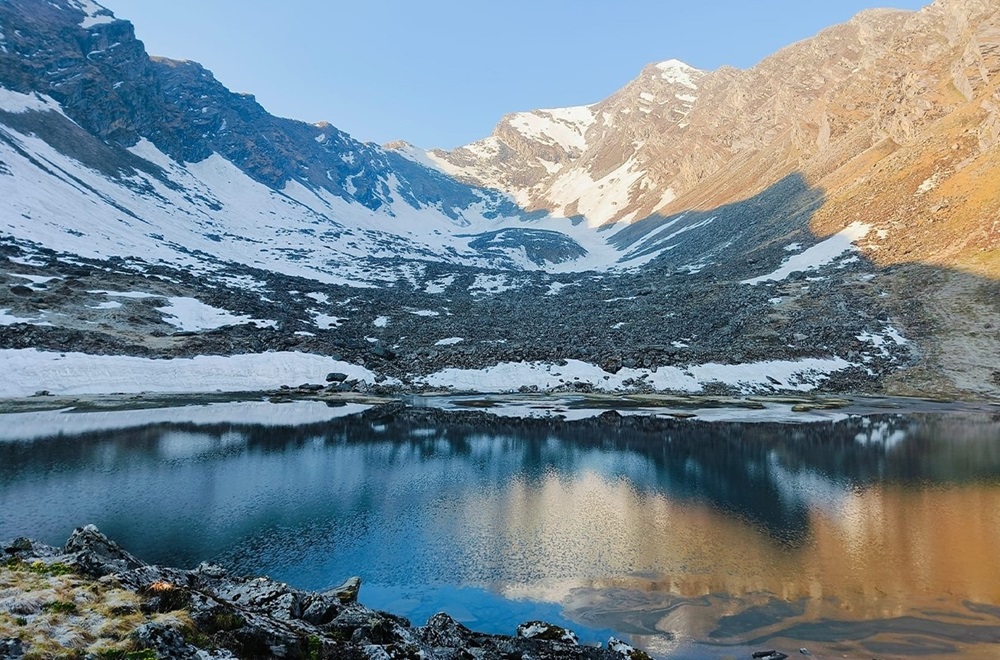
Devi Kund Uttarakhand
Discovery of Swastik Parvat Near Devikund
On June 22, during the foundation laying ceremony of Anandeshwari Temple at Devikund, locals and visitors observed a striking natural pattern on a nearby snow-clad peak. The formation clearly resembled a Swastik, a symbol revered in Hinduism, Buddhism, and ancient Indian culture as a sign of prosperity, cosmic order, and divine energy.
Although discussions around the Devikund Temple construction created some controversy, residents strongly believe that the emergence of Swastik Parvat should not be overshadowed. Instead, they see it as a divine sign and a heritage discovery for the entire state of Uttarakhand.
Religious Significance of Swastik Parvat
In Hindu tradition, the Swastik symbol represents:
-
Auspicious beginnings
-
Solar energy
-
Balance of the universe
-
Divine protection
The appearance of this symbol naturally formed on a Himalayan peak has deep spiritual implications. Similar to Om Parvat, Swastik Parvat is believed to be a manifestation of divine geometry created by nature itself.
Many devotees and spiritual thinkers believe such formations appear only in highly sacred landscapes, strengthening the belief that Sundardhunga Valley is spiritually charged.
Connection with Nanda Devi Puja and Local Traditions
The region around Devikund holds immense cultural importance for nearby villages such as Badiyakot. Every year during September–October, villagers visit Devikund to:
-
Collect Brahmakamal (sacred Himalayan flower)
-
Perform rituals related to Nanda Devi Puja
During this period, local movement increases in the valley. Interestingly, May and June see comparatively less snow on the Swastik Parvat peak, making the symbol more visible.
Government and Leaders’ Views on Swastik Parvat
The discovery of Swastik Parvat in Bageshwar has received attention from political leaders across parties.
Government Support
The Chief Minister of Uttarakhand has shown strong interest in promoting the site responsibly.
“No effort will be spared in the upliftment of Swastik Parvat,”
— Suresh Gadhia, MLA from Kapkot
Political Consensus
-
Indra Singh Farswan, BJP District President, called the emergence a significant achievement and confirmed that the government is serious about its development.
-
Kavi Joshi, District Secretary (Organization) of Congress, emphasized that both state and central governments should collaborate to unlock the religious tourism potential of the Devikund–Sundardhunga region.
This rare consensus highlights the cultural importance of the discovery beyond political lines.
Tourism Potential of Swastik Parvat in Uttarakhand
With proper planning, Swastik Parvat can become a major spiritual destination, similar to:
-
Om Parvat
-
Adi Kailash
-
Hemkund Sahib
-
Nanda Devi Raj Jat route
However, experts and locals stress that development must be:
-
Eco-sensitive
-
Community-driven
-
Respectful of local traditions
Unregulated tourism could harm the fragile Himalayan ecosystem of Sundardhunga Valley.
Best Time to Visit Swastik Parvat Region
-
May–June: Less snow, better visibility of the Swastik formation
-
September–October: Cultural significance due to Nanda Devi Puja
-
Monsoon (July–August): Not recommended due to landslides and heavy rain
-
Winter: Region mostly inaccessible due to heavy snow
How to Reach Sundardhunga Valley (Brief Guide)
-
Nearest Town: Bageshwar
-
Nearest Railway Station: Kathgodam
-
Approach Route: Bageshwar → Kapkot → Khati village → Trek towards Sundardhunga
(At present, Swastik Parvat is visible from surrounding areas; trekking routes may be regulated in the future.)
Conclusion
The discovery of Holy Swastik Parvat in Sundardhunga Valley, Uttarakhand, is more than a geographical curiosity—it is a moment of deep spiritual and cultural significance. Much like Om Parvat, this naturally formed sacred symbol strengthens Uttarakhand’s identity as Devbhoomi, the land of the gods.
With thoughtful planning, ecological sensitivity, and respect for local traditions, Swastik Parvat near Devikund has the potential to emerge as one of India’s most revered spiritual landmarks—benefiting local communities while preserving the sanctity of the Himalayas.