
Champawat Tigress: The Deadliest Man-Eater in Indian History
The Champawat Tigress remains one of the most terrifying legends in the history of Indian wildlife. Active in the early 20th century, this Bengal tigress terrorized villages across Nepal and the Kumaon region of Uttarakhand, earning a grim reputation as the deadliest man-eating tiger ever recorded.
According to historical records, the Champawat Tigress was responsible for the deaths of 436 people, a number that placed her in the Guinness Book of World Records and etched her story permanently into folklore and conservation history.
Who Was the Champawat Tigress?
The Champawat Tigress was a Bengal tigress that lived in the dense forests of the Himalayan foothills. Unlike normal tigers that hunt deer or wild boar, she turned into a man-eater due to severe physical injury.
Post-mortem studies later revealed that:
-
She had broken upper and lower canine teeth
-
Likely caused by an old gunshot wound
-
This made hunting natural prey extremely difficult
Forced by hunger, she began attacking humans—slow-moving and unprotected targets.
Suggested Read: Modi Trail: A Trek Through Jim Corbett’s Wild Heart

The Champawat Tigress in Nepal
Her reign of terror began in Nepal, where initial attacks were scattered and largely ignored. At the time, wildlife encounters were common in remote villages. However, as killings increased rapidly, fear spread across the region.
By the time authorities reacted:
-
Over 200 people had already been killed
-
Entire villages were abandoned
-
Economic activity collapsed due to fear
The Nepalese Army attempted to hunt her but failed. Eventually, villagers and soldiers managed to drive the tigress toward the Sharda River, which marks the border between Nepal and India.
She crossed into India—and the nightmare followed.
Terror in the Kumaon Region of Uttarakhand
Once in India, the Champawat Tigress established her territory around Champawat, from which she took her name.
Her hunting behavior was unusual and frightening:
-
Attacked during daylight, not night
-
Targeted women and children
-
Killed in different villages to avoid detection
-
Showed no fear of humans
The Kumaon hills lived in constant panic. Schools closed, farming stopped, and people refused to leave their homes alone.
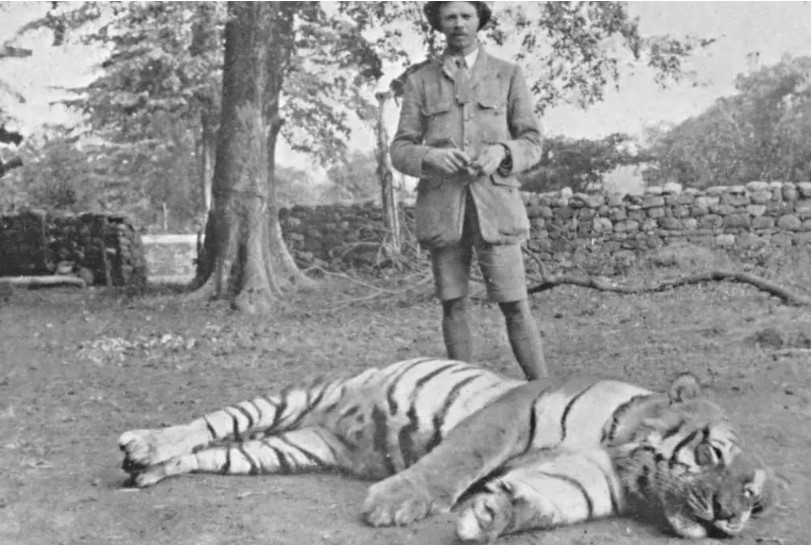
Jim Corbett and the Champawat Tigress
The crisis reached such an extreme level that the British administration called upon Jim Corbett, a renowned hunter with deep knowledge of forest behavior.
In 1907, after the tigress killed a 16-year-old girl, Corbett tracked her by following the blood trail left behind. After a tense pursuit, he finally shot and killed the tigress—ending seven years of terror.
Post-Mortem Findings
-
Broken canines confirmed
-
Estimated age: 10–12 years
-
Otherwise healthy body
This proved that injury—not instinct—had turned her into a man-eater.
How the Champawat Tigress Changed Jim Corbett Forever
Killing the Champawat Tigress deeply affected Jim Corbett. For the first time, he fully understood how human actions—especially hunting and habitat destruction—can push wild animals toward conflict.
This moment transformed Corbett:
-
From hunter → conservationist
-
From killer of man-eaters → protector of wildlife
His experience directly contributed to the creation of Jim Corbett National Park, India’s first national park, originally known as Hailey National Park.
Legacy of the Champawat Tigress
The story of the Champawat Tigress is more than a tale of fear—it is a lesson in human-wildlife conflict, compassion, and conservation.
It teaches us that:
-
Wild animals attack humans only when forced
-
Habitat loss and injuries create man-eaters
-
Conservation is the only long-term solution
Today, her legacy lives on through wildlife protection efforts and tiger conservation programs across India.
Final Thoughts
The Champawat Tigress remains a haunting reminder of what happens when nature and humanity collide. While her story is tragic, it also sparked one of India’s most important conservation movements.
If you visit Uttarakhand today, tiger safaris and protected forests stand as living proof that coexistence is possible—when wildlife is respected and protected.
This article is regularly updated to reflect historical research and conservation insights.